

aGLIFF 2010 Daily Dispatch: Day Five, or I Had No Idea "Owl" Is an Acronym
Here's something you don't see every day, even in eternally weird Austin: a half-dozen men in full-tilt -- and I do mean full-tilt -- drag queen mode parading around a theater lobby.
Even amid the organized mayhem of a crowded Saturday afternoon at aGLIFF, it was impossible to miss the drag queens – all members of the Mardi Gras Krewe of Armeinius – as they entered the Alamo Drafthouse lobby. In costumes that no mere words could ever describe (and no – I will not resort to calling them fabulous!), the sequined and bewigged gentlemen were at the theater for a screening of The Sons of Tennesee Williams, a documentary about the Krewe's history. They also appeared at the festival's Centerpiece Party on Saturday night.
I wish I could say the films I saw on Saturday afternoon were as fabulous! as the Krewe of Armeinius (oops – I just called the Krewe fabulous!, didn't I). Unfortunately, this isn't the case, although all three films were interesting.
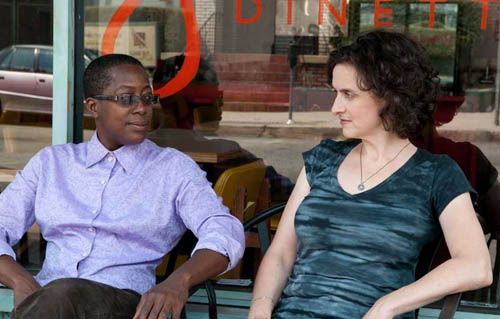
My first screening of the day was The Owls (pictured above), a crime drama about two middle-aged lesbian couples involved in covering up the death of a younger lesbian. When a stranger enters their lives, they're forced to confront their dark secret and the nature of their relationships. The Owls (in this case, owl means Older, Wiser Lesbian – who knew?) has an unconventional structure that combines narrative action and interviews with the actresses, who discuss their characters, plot points and issues related to sexual orientation and gender identity.
While the film's nobly experimental structure is interesting, it doesn't quite work. At only 66 minutes, The Owls gives none of its half-dozen characters enough screen time to fully develop; they're so one-dimensional that even the actresses' numerous comments don't really flesh them out. The story never goes anywhere or builds the expected crime-drama tension, and the characters aren't at all likeable. On the other hand, as the faded rock star Iris, The L Word's Guinevere Turner does a bitchily superb job of being completely unlikeable.
The Owls includes a few funny moments and astute observations about lesbian relationships. But the action and dialogue often drag or feel overly amped and seem designed to deliver a message about accepting alternative gender identities, rather than tell a story.
The film's discussions of gender identity are interesting, but they seem out of place and distracting in a film that also tries to be a noir-ish whodunit. On a positive note, the film's premise is intriguing; with a more conventional structure, longer running time and more focused and polished script, The Owls might have been a gripping thriller with equally gripping gender identity-related undertones.
I had to miss most of the post-screening Q&A with The Owls director Cheryl Dunye to get in line for Freeing Bernie Baran, a documentary about a shocking miscarriage of justice.
In 1985, 19-year-old day-care worker Bernie Baran, who is openly gay, was wrongly convicted of child molestation. His trial -- conducted amid the mid-1980s hysteria sparked by the McMartin preschool abuse trial -- was a complete farce. Baran's lawyer was totally incompetent, doing no investigation and calling no witnesses. Even worse, the prosecution violated many basic rules of conduct, basing their case on misleading, heavily edited videotaped testimony from young children and "misplacing" evidence that easily could have exonerated Baran. Baran spent more than 20 years in prison; he finally was released in 2006, but only after an experienced team of lawyers fought a years-long legal battle on his behalf.
Baran's captivating, infuriating story is, of course, the stuff of which great documentaries are made -- but sadly, Freeing Bernie Baran isn't a great documentary. It tells Baran's story coherently, but suffers mightily from choppy, jarring editing, odd visuals, overused explanatory titles and cloying sentimentality. Many of the interviews are so badly edited that they're almost unwatchable, as the interviewees' images jump distractingly around the screen against a static background, sometimes repeatedly within a single sentence. Some visuals, such as images of fireworks, are either too obvious or have no apparent connection to the story; others, such as an oft-repeated shot that quickly zooms in on a sign above a courthouse door, are nearly nausea inducing. Also, there are times when the screen inexplicably fades to black; more than once, this happens when someone is talking. In contrast, at the film's end are some nicely shot sequences with the newly freed Baran and his long-suffering mother, but these sequences go on too long and become cheaply sentimental.
I don't want to sound overly harsh in reviewing Freeing Bernie Baran, and I give its creators a lot of credit for telling an important story that the media largely ignored. But although the film is a good resource for anyone wanting to learn about Baran and the hysteria that sent him to prison, its amateurish execution doesn't do justice to his heartbreaking tale.
However, I did enjoy a post-screening Q&A with Baran, director Daniel Alexander, and others involved with the film. Despite all his suffering, Baran answered the questions with more optimism than bitterness. Fortunately, his life is moving in a positive direction; he's working now, and his attorneys are seeking financial compensation for him.
On a much more positive note, I also enjoyed Out of Annapolis, a seamlessly produced documentary about gays and lesbians who attended the U.S. Naval Academy. Consisting entirely of interviews with gay and lesbian academy alumni, Out of Annapolis deftly explores the difficult times they endured as they pursued military careers while hiding their sexual orientation.
Out of Annapolis is moving, infuriating and often very funny, with some surprising revelations about how gays and lesbians manage to survive in the military's often hostile environment and tiptoe around the absurd "don't ask, don't tell" policy. The film isn't especially artful, but it's nicely shot, flawlessly edited, and very entertaining. It engenders plenty of sympathy for its subjects, but isn't totally unsympathetic toward the military; curiously, the interviewees -- all of whom have left the Navy and now live openly gay lives -- consider their years of military service to be positive experiences and do not regret joining the military, despite how it treated them at times.
After the screening was a very enlightening Q&A with three Naval Academy graduates who appeared in the film -- director Steve Clark Hall, Brian Bender and Austin singer/songwriter Heather Davies, who contributed several songs to the soundtrack. During the Q&A, Hall explained that Naval Academy officials were surprisingly cooperative. Despite the film's controversial subject, they allowed him plenty of access to film on the campus. This is, of course, a hopeful sign that attitudes toward gay and lesbian service members are changing.
I'll be back tomorrow for the sixth and final day of aGLIFF, and look forward to seeing the Queer Youth Media Project/My Queer Movie short films and Faith of the Abomination, a documentary about two lesbians who went undercover disguised as a straight couple to infiltrate an Austin evangelical Christian church.