

aGLIFF 2010 Daily Dispatch: Day Three, or F**k the Patriarchy
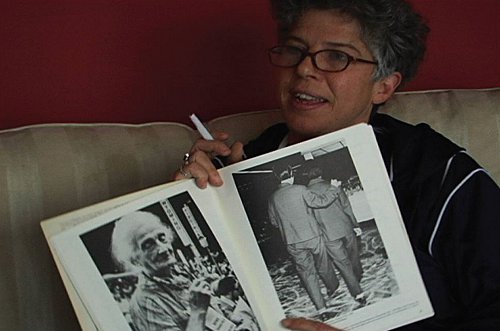
Out of my way, all of you. I Am Empowered. I am ready to ... well, I'm not sure what I'm ready to do, but I certainly feel empowered to do it as soon as I figure it out. I saw The Heretics at aGLIFF last night, and it definitely made me feel like I should be doing something more in the name of feminism. We may have to get rid of Don and have only female contributors at Slackerwood (no, not really ... I like our male contributors way too much), or start the contemporary equivalent of a consciousness-raising group, or something. I felt this way in college but frankly, over the years I haven't done much about it, which is disappointing in retrospect.
The Heretics was my first film of aGLIFF this year, and it was a wonderfully energetic way to begin the fest. I Killed My Mother was the most popular film in the early-evening timeslot last night, nearly selling out, but The Heretics had a wonderfully energetic crowd, mostly women, ready to enjoy this documentary about a unique publication started by second-wave feminists in the 1970s. I realized as the film intro began that I was sitting a couple of seats away from the BookWoman owner -- the bookstore sponsored this screening, and the owner reminded us that BookWoman is one of only a dozen feminist bookstores left in the U.S. (They also frequently have Movie Nights. But I digress.)
Before we saw the documentary, aGLIFF screened a short film called Swimming, which centered around a song by Austin singer-songwriter Gretchen Phillips, who appeared in the short and also was its scriptwriter. Phillips was in the audience for the films and did a short Q&A afterward. Swimming was a cute, sweet film about yearning, specifically a lifeguard yearning for one of the frequent patrons of her swimming pool. The water images were lovely. Before the film started, aGLIFF Programs Director Jake Gonzales told us that the fest programmers liked the short so much, they scheduled it in front of three films this year.
The Heretics opens with filmmaker Joan Braderman talking about her early feminist experience in New York, and how she became involved with Heresies, a publication started by NYC women in the early 1970s. Braderman and her film crew -- two women in their twenties -- travel from NYC to Venice and other locations to track down all the women in the collective that started Heresies, to talk to them not only about the history of the publication, but also their history of feminism and how it affected their art. Some are visual artists, some are writers. They are what is called "second-wave feminists," a term I hadn't heard before to describe feminists from the 1960s and 70s, and I started wondering what wave I am in. If any. Third wave? Fourth?
The documentary's structure takes a few minutes to settle -- it begins with some summaries of what we're about to see, and a little globetrotting, but then settles into a rhythm that is loosely based on timelines, but incorporates a number of interviews, artwork from Heresies, and some video clips from the era. The talking-heads format is softened by having the subjects interviewed in their studios, showing off their art and design work and creating some visual interest. It also made me interested in some of the artists' work and now I want to find out more about them. Fortunately, the Heresies articles are now online.
After The Heretics ended, I ran into Jenn Brown and we found seats for The Adults in the Room, an autobiographical film from Portland that was part-feature, part-documentary in style. The audience was very different for this film -- we were surrounded by guys. We both made little excited noises when the list of sponsors flashed onscreen and there was Slackerwood. (Which meant that the gentleman next to me asked which sponsors we were, and we gave them our cards. Spontaneous excitement can lead to promotion. I find this amusing.)
But first, a short -- nearly all aGLIFF features are preceded by shorts. After, a short by Mark Paricelli, was about three middle-school boys watching attractive young men play street football, and fantasizing. I liked the first part, but the end was too jarring for me. It fit interestingly with The Adults in the Room, which also deals with teenage boys and sexuality.
The Adults in the Room is about filmmaker Andrew Blubaugh, who starts writing a script based on his high-school years, when he had an affair with a man in his thirties (and the father of one of his schoolmates). At the same time, Blubaugh's hometown of Portland is rocked by scandal when Mayor Sam Adams confesses to having sex with one of his male interns. Blubaugh has to decide whether it's appropriate or possibly even dangerous for him to make a film that does not censure an adult for having sex with a teenager ... especially since Blubaugh teaches filmmaking to high-school kids.
This decision-making process, in which Blubaugh talks with friends, social workers, and even Dan Savage, is interspersed with a narrative based on his script, in which we see the character of Teenage Andy as he struggles to deal with his affair with older Peter, and has to hide this side of his life from his dad and his school. Teenage Andy is also starting to deal with the possibility that he might want to be a writer when he grows up.
The Adults in the Room felt a little talky near the end -- or maybe it was just me up past my bedtime -- but thought-provoking and interesting. I don't think Blubaugh's script would have held up as a stand-alone film, not because of the subject matter but because the parts we see have no subplots or subtext, and characters speak directly about whatever they are feeling. However, it works effectively in the context of the film.
I also don't know whether the "documentary" parts of this film were really a documentary, or if Blubaugh scripted most of it. Some of the scenes feel a little too convenient. However, this didn't bother me a bit -- it didn't matter in the context of the film. This intrigues me because I felt entirely different about Catfish, but that's a story for another day.
Tonight, I'll be back at aGLIFF, and am hoping to catch two entirely different movies. I plan to start off with the BBC costume drama The Secret Diaries of Miss Anne Lister, based on the real-life diaries of a 19th century British lesbian gentlewoman. I'm following this up with a Dallas film, because of course I want to support Texas filmmaking, and how can I resist something with the title Ticked-Off Trannies with Knives? This movie has generated a lot of controversy and I'm pleased that aGLIFF is showing it so I can see for myself whether it's offensive or just a fun variation on the exploitation genre. Hope to see some of you there!