

Interview: Tim Blake Nelson and Edward Norton, 'Leaves of Grass'
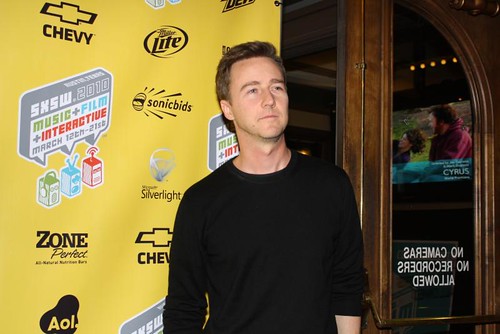
Austin fans of actor Edward Norton (Fight Club, American History X) will be able to get a double -- or should I say triple -- dose of him this weekend with two major film events. Norton will be in town for the premiere of Stone at Fantastic Fest on Friday, September 24 at 7 pm -- a gala screening at the Paramount Theatre. He'll also be at Alamo Drafthouse at the Ritz for the sold-out 8 pm showing of Leaves of Grass, which opens in Austin this weekend.
Don't assume Leaves of Grass is a "stoner comedy," as I almost did. This movie defies typecasting into one genre, as it ranges from comedy to drama to thriller. Norton stars as twin brothers -- Bill, a straight-laced Ivy League professor; and Brady, an uncultured pot grower in the backwoods of Oklahoma. Actor and director Tim Blake Nelson also wrote the screenplay, which is centered more around classical tragic themes in such a manner that viewers won't take long to forget that the characters are played by the same actor.
I sat down with several other film critics during SXSW this past March for a roundtable discussion with Norton and Nelson the day after Leaves of Grass played the fest. To find out why Nelson has inspired me to read classic Latin literature, read his and Norton's responses to our questions after the jump, and check out my review of the film appearing later this week:
Tim, as an actor and a director, do you like to involve yourself in films that act as a corrective to Southern stereotypes or don't treat Southern characters as easy laughs?
Tim Blake Nelson: Yeah, I certainly do. I do grow tired of intelligence having such a limited manifestation in movies, usually meaning coastal and a certain level of formal education. When I wrote this [Leaves of Grass], I knew immediately that the wisest and smartest two characters in this movie would be the ones who either remained in Oklahoma or returned there. The smartest guy in the movie is Brady. I think that's evident, and it's also stated by the mother. And the wisest character is Keri Russell's character, and she's chosen to return and write in Oklahoma. She gives the Bill character the wisdom that allows him to begin to move forward in his life as it's collapsing around him. In answer to your question, I was eager to debunk certain stereotypes about Southern characters in this movie.
To believe in the duality of the story and Norton's roles, you have to have a suspension of disbelief. I'd like to hear how you two achieved it.
Tim Blake Nelson: Suspension of disbelief in a story like this is pretty essential. That said, you have to be responsible to your story as a storyteller to make it feasible enough, and I hope that this story is feasible enough. There are details peppered throughout. I didn't want to bang the audience over the head with it. An obvious question would be, "Hang on, wouldn't people know they were twins?" -- but they didn't grow up in the Idabel /Broken Bow area. They grew up in another town, and Brady has moved to Idabel.
These stories are all far-fetched, but the antecedent material for the movie, like in Menander and Plautus and Shakespeare, it's a retelling of a twins genre. The main character in the movie is a classicist, so that's all very intentional. It's meant to reflect on those earlier works. The character Bill has done a translation of Plautus' play, The Menaechmi, which is a Roman twins play. So suspension of disbelief, and that whole question, is part of the fun of the movie. Okay, now Ed is going to say, "Thanks for referencing Menander."
Edward Norton: I was actually going to say that any questions I had about whether a redneck from Oklahoma could actually become a Brown classical philosophy professor ended when I met Tim. One conversation with Tim and you realize, "Oh, Bill is a believable character."
I agree that there are not only archetypal characters, but types of stories going way back to classical drama that have certain structures of suspension of disbelief. I thought that the two worlds it was trying to straddle was delightful, and I loved it. It was not something I had ever seen before, which is always hard to find. Tim is so authentically rooted in both of those worlds. You know when you are being driven by someone who knows where they're going. You can feel that when you read a script and when you see a movie -- that was a big part of the appeal of it to me. It was clearly a film that only Tim knew how to make, because he owned it all.
If there's a criteria that really tends to get me interested in a piece of work, apart from any kind of personal reaction I have to the themes, if I feel like this is the right piece of work for that director at this moment in their career. That's a big draw. I felt that way with Fincher on Fight Club. I felt like this is the guy to handle this text and really hit it out of the park. I felt that way about Spike Lee on 25th Hour or David Jacobson in Down in the Valley. If you feel like someone just knows what this is about to their core and knows how to bring their personal style to it, it's gonna have that kind of special confidence in it. For me, the only thing that I really wanted us to be careful of was that the twins never felt like a trick, that you stopped looking at the seams and you felt that these guys were inhabiting the same space and interacting with each other in a very extemporaneous way.
Tim, how did you, as a director and acting in the movie, economize those two performances so you could buff out the seams and make sure that you were at least getting enough into camera to make this thing completely believable?
Tim Blake Nelson: Remarkably, there's no green screen in this movie. There's motion control. Technically, there were all sorts of challenges, but really the soul of it is Edward's talent. You write these characters, but when you write a movie, and all you can hope for and depend on is that your actors will elevate the material. Because screenplays aren't written to be read; they're written to be turned into movies.
What's so remarkable about Edward, and that I think comes through so beautifully in his performance in the movie, is that he's so truthful as an actor. The source material from within him is so gorgeously accessed that the dramatic bass notes in the movie, such as when he's eulogizing his brother, are just exquisitely rendered. At the same time, he's able to play the loopy, comic moments. So few actors have that sort of bandwidth.
But what Edward also brings to you as director is this incredible mind. To play these twins, it was quite a juggling act, because he has to -- and he'll talk about this, but he's not going to compliment himself, so I'll just enjoy the floor for a moment. It takes a rare mind to be able to map out a scene as character A in a way that will leave room for character B and how that character might respond. It's almost a cubist way of thinking, you're looking at the scene from all sorts of different angles. He just has the ability to do that, and to do it truthfully. I had a huge advantage with Edward because he's directed a movie before, so one thing he appreciates is how hard my job is, he was also very sensitive to that. We actually ended up finishing this movie a day early.
Edward Norton: There's a little bit of Dirty Dozen in it. Donald Duck goes here. You have a no-room-for-error scenario in terms of where is there. If there was a day where the twins are on the porch together, it has to be finished that day. The thing we did the best on this was prep. If you map it, then you leave yourself more room to play. We had a very clear roadmap of how we were going to handle it technically, and in what order. We didn't sit around saying "Maybe we should try to do X," which gave us a little bit more breathing room.
Tim Blake Nelson: We would get Brady done first, set a performance which Edward and I were both happy with – and that was a collaboration. With somebody like Edward you never say, "This is the one we're going with whether you like it or not." It has to be something we agreed on.
Edward Norton: Once we laid down stuff, we pretty quickly gravitated towards, "Yeah, that's what we wanted." Sometimes if I had an idea by doing it a couple times, even in something regimented like this, there are fun ways to improvise. And when you start playing with what these techniques can do when you start realizing there's actually not one clean line on the screen past which one character can't go, it can shift.
Sometimes right in the moment I would have a thought -- like to have one character go over and fake kick the other one. The mirror shot was fun, and we realized we could actually have them touch if we did the angles right. Sometimes we would throw down some improvisational stuff and see if it would stick. It only takes one or two moments per scene of people overlapping in conversation or interacting in a way that feels authentically extemporaneous enough to take away the idea of the effect. They do some things now in twin scenes now you couldn't before. You can do this stuff with actual moving cameras now.
Either prior to this film or during, did either of you ever try noodling, and how did you get Keri Russell to do it?
Tim Blake Nelson: I've done about every kind of fishing you can imagine, but I've never noodled. And the reason I've never noodled is because I don't want to get bit by a water moccasin. I'm just too afraid of snakes. Getting Keri Russell to do that was about the easiest chore I had as director on this movie. She had a great attitude about it. She and Edward were fantastic together. You dream as an actor's director of being able to let moments breathe in two-shots, and one of my favorite moments in this movie is just letting the camera sit on Edward and Keri on that porch in a two-shot, when he tries to kiss her. It goes on for several minutes, and I never had to cut to a close-up. They're so exquisite together, it's just great.
In playing twins, how does that change your approach? How do you go about creating both characters? And Tim, being the writer and director, and as an actor does that make your job easier or harder?
Edward Norton: It's the same as always, just twice. I hear people talk about some actors being intellectual actors, some people being instinctual actors, and I always think it's kind of crap. I think anybody who knows anything about it knows that good actors sort of do both. They do inside-out work and they do outside-in work. You can't not do both. In something like this, Tim's provided a lot of good work on the inside-out. He's given you in a script like this a lot about who these characters are emotionally. You've got a great road map to that.
With these guys, it was a little more outside-in, not in an intellectual sense, but just in a tactile sense: what do they wear and how do they sound -- finding the skin of them. In terms of the twins in particular, the only thing I thought was interesting was that it was very difficult to find anybody who was an identical twin who didn't focus on how much they were alike. Identical twins are endemically alike in many ways. That brought up interesting conversations between us, because the script is emphasizing their apparent differences, but then we started talking about all the ways they're actually the same. We added the line that Bill says, "You're still using vinyl," and Brady says, "I don't go for digital. You can't improve on the classics." He's really the same as Bill. He's just as committed to a set of classical values. His just happen to be Little Feat and Townes Van Zandt.
Tim Blake Nelson: I've never acted before in a movie I've directed. This felt like the time to do it just because the movie itself is so much of a platform for the lead actor. It's really written for an exciting performance and it really depends on the audience watching an extraordinary actor having a great time pulling off this feat. It makes sense to me as the director to act in support of that. To be around as a sidekick doesn't say much, but [Bolger] is around to help both characters out of certain problems.
Edward Norton: He tried to punk out, but we, the producers, wouldn't let him. We were trying to imagine a better face for Bolger and it was hard to come up with one.
Tim Blake Nelson: But it was a lot of fun.
Edward Norton: Mainly, he just wanted to wear a doo-rag.
Edward, in your career it's been rare for you to do movies that are primarily comedies. Did the fact that this was a comedy attract you to the film, and can we expect to see you in more comedies in the future?
Edward Norton: I don't tend to say it's time for one of this or that genre. Things flow to you in a strange way, and why you bump into a certain kind of thing in a certain moment ... it's hard to explain. I knew Danny DeVito and he knew me, so he really wanted me to do Death to Smoochy. I love that stuff, and had a great time doing it. To me, Fight Club was a comedy. When Fincher sent me the book, I read it, and the first thing I asked him was, "This is a comedy, right?" And he said, "Oh, yeah, that's the whole point." And I said, "Okay, I'm in." I certainly wasn't imagining myself as a dramatic actor when I was running around in my underwear and Florsheim shoes. I thought Rounders was a comic movie in its way, too.
The first time I directed a movie I wanted to do a comedy. I like things that aren't superficially one thing or another. My favorite comedies are ones that are really smart, too. When we worked on Keeping the Faith, I was looking at a lot of Cukor's old films like The Philadelphia Story, which was hilariously funny but also really, really smart and had a kind of cutting critique in the humor, too. This [Leaves of Grass], when I read it, mainly I was laughing a lot at the lines. I remember reading Brady saying, "Not the Merriam-Webster, either, the motherfucking O.E.D." For me there's always a line or two in a script where you almost decide to do the movie, and that was it. There were a few things like that. You almost do it for the fun of getting to say a line or two like that. So, I don't have any specific plans. If Seth Rogen calls with a great buddy pic, I'll be there.
Leaves of Grass opens in theaters on Friday, September 24. Check back later for my review.
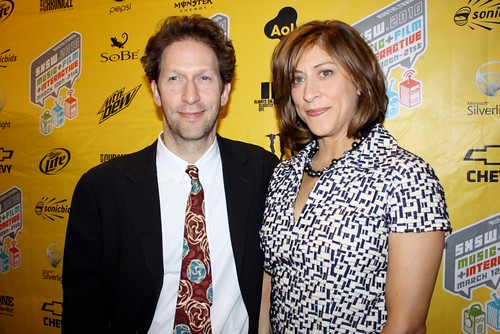
[Photo credits: Edward Norton at SXSW, Tim Blake Nelson and Lisa Benavides-Nelson on the Red Carpet, by Debbie Cerda, on Flickr]