

DVD Review: Temple Grandin
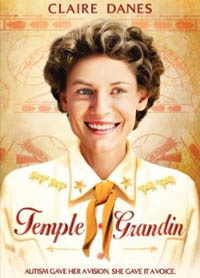

Such an inspirational and thoroughly unique story is, of course, tailor-made for a cinematic treatment. Fortunately, this treatment is Temple Grandin, a much-lauded HBO Films biopic nominated for an astounding 15 Emmy Awards. Released this week on DVD
The film opens in 1966 as a teenage Grandin (a barely recognizable Claire Danes) arrives at the Arizona ranch of her Aunt Ann (Catherine O'Hara) and Uncle Mike (Michael Crabtree), who are caring for Grandin to relieve her exhausted mother, Eustacia (Julia Ormond). Grandin exhibits many classic autism symptoms: She constantly repeats random phrases, fixates on objects, is extremely sensitive to stimuli, has trouble interacting with people and confronts new experiences with fear and confusion. But while at the ranch, she also demonstrates an unlikely talent for designing and building mechanical devices and an innate understanding of animal behavior.
Grandin blossoms at the ranch, and being far more comfortable around animals than people, she wants to stay. Despite her protests, however, Eustacia enrolls her at Franklin Pierce College in New Hampshire. Her introduction to college life is mostly disastrous, and in a prolonged flashback to her childhood and high-school years, we learn why.
The flashback begins with Grandin's tantrum-prone early childhood. Seemingly lost in her own world and unable to talk, she is diagnosed with autism at age four. With her mother's help, she eventually learns to talk and functions well enough to attend school. But her behavioral problems are many, and she suffers endless torments from her classmates. Expelled from high school for hitting another student, she enrolls at Hampshire Country School, a New Hampshire boarding school where she meets Professor Carlock (the always impressive David Strathairn), a science teacher who discovers the key to teaching Grandin: She thinks in pictures, not words.
From this pivotal moment, the film moves along briskly, detailing Grandin's life at Hampshire and Franklin Pierce, where she excels academically while still lacking many basic social skills. When she pursues a graduate degree and career in animal husbandry, this social awkwardness -- combined with hopelessly sexist attitudes in the male-dominated cattle industry -- is an enormous barrier. But even the most misogynistic feedlot boss is no match for Grandin's smarts and drive.
Temple Grandin is a solidly made biopic, with enough good performances and artsy touches to be several steps above most feel-good, inspirational made-for-TV films. The script is well researched (it's based on Grandin's book, and she was a script consultant), with only a few hints of melodrama. Director Mick Jackson (L.A. Story) keeps everything moving quickly enough to avoid becoming mired in disease-of-the-week weepiness or unnecessary reverence for the film's spunky heroine.
For all the film's merits, I do have a few complaints. It relies too heavily on quick cuts and visual effects to show how Grandin experiences the world, namely her susceptibility to sensory overload and talents for photographic recall and mathematical calculation. From start to end, many split-second sequences are awash in DayGlo colors and overly amped noises, as ceiling fans whoosh, knives bang on cutting boards and all manner of quiet sounds become harsh. We also see visual stimuli through Grandin's eyes, captured as black-and-white photos or transformed into engineering drawings. These effects are striking, but they're overused to the point of being annoying. It takes only a few such frenetic montages to understand how Grandin's mind works; beyond this, only an occasional reminder is necessary.
Another complaint is that Temple Grandin overuses a totally clichéd metaphor about opening doors (illustrated with shots of opening doors, in case we don't quite get it). Also, an awkward scene near the end in which Grandin gives an impromptu, overly convenient speech about autism doesn't feel real, but seems tacked on to make sure we understand the importance of autism treatment.
Aside from these relatively minor flaws, Temple Grandin is solidly entertaining, with a standout, amazingly dead-on performance from Danes. (She's irritating at times, but this irritation is essential to the role.) It's essential viewing for anyone wanting to learn more about its truly fascinating title character.
DVD Extras: The DVD
The Making of Temple Grandin is a short but very slick documentary featuring interviews with Jackson, several cast members and Grandin herself. After seeing the real Grandin in the documentary, it's obvious that Danes captured her quite well and deserved her Emmy nomination.
The audio commentary features Jackson, co-writer Christopher Monger and Grandin, who does most of the talking. The commentary is very enlightening, as the three point out the film's painstaking authenticity, as well as examples of poetic license. The commentary also includes many insights about autism, and I recommend it for anyone wanting to learn more about the condition.
Austin/Texas connections: Temple Grandin is set mostly in New Hampshire and Arizona, but was filmed entirely in Austin, Lockhart, Georgetown and Dallas. Several familiar local actors appear in the film, including D.J. Castillo of Friday Night Lights and perennial bit player David Blackwell.