

DVD Review: The Messenger
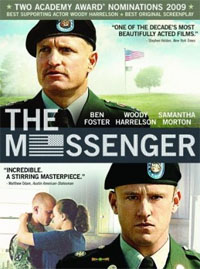 For much of the last decade, most films about the wars in Iraq and Afghanistan failed to find audiences or garner much critical praise. From The Situation to Home of the Brave to Stop Loss, war-related films usually opened to tepid reviews and disappeared with little notice. As America's two wars dragged on, filmgoers showed little interest in seeing the carnage at their local multiplex, and critics dismissed most of the films as clichéd or unrealistic.
And then, of course, The Hurt Locker changed everything. A brilliant multi-Oscar winner and solid box office success, Kathryn Bigelow's harrowing tale of an Army bomb squad proved that an exceptionally well made Iraq war film could indeed satisfy critics and audiences.
Unfortunately, somewhat lost in the glare of Oscar-season hype surrounding The Hurt Locker was another glowingly reviewed, Oscar-nominated, must-see Iraq war film released late last year -- The Messenger, available today on DVD and Blu-ray. Directed and co-written by Oren Moverman, the film first screened locally during Austin Film Festival in 2009.
A rawly emotional and yet thoughtful story, The Messenger follows two Army officers assigned to what is perhaps the military's toughest duty: casualty notification. It is their mostly thankless job to tell the next of kin, face to face, that their loved ones have been killed.
The younger of the two officers is Staff Sergeant Will Montgomery (Ben Foster), freshly returned from a tour in Iraq and still recovering from serious injuries from a bomb blast. With only a few months left in his enlistment, Montgomery is understandably unhappy with his final duty assignment. He also takes an immediate dislike to his new partner and mentor, Captain Tony Stone (Woody Harrelson), a career soldier whose by-the-book mentality and emotional detachment make Montgomery's job all the more unpleasant.
Of course, calling the job merely "unpleasant" does not do justice to the emotional horrorshow Montgomery and Stone face each time they carry out their awful duty. The reactions range from hysteria to violent rage to the unsettling calm of someone too stunned to react at all. The two officers try mightily to stick to their script, but this is almost impossible when a dead soldier's mother is having a meltdown or a father threatens to physically assault them. Amid these unpredictable but always painful situations, the protocol-bound Stone and the openly compassionate Montgomery clash at nearly every turn, although eventually they develop a grudging friendship.
One cardinal rule of notification is not to get involved in any way with the next of kin, but Montgomery does exactly that after telling a young mother, Olivia Pitterson (Samantha Morton), that her husband was killed in action. Her oddly dispassionate reaction piques his curiosity about her, and although she initially resists him, the two soon become friends who tiptoe around the obvious (and obviously unwise) possibility of a relationship. (Montgomery is recovering from more than just physical wounds. While he was in Iraq, his girlfriend got engaged to someone else.)
Unlike many films of its genre, The Messenger avoids politicking and openly preaching against war. Of course, any film about war deaths is inherently anti-war, but The Messenger is less a polemic than a personal story about loss and grief. It focuses entirely on war's home-front aftermath of shattered lives and empty souls. Although not overly grim (and even reassuringly hopeful at times), it's often difficult to watch, delivering a draining emotional wallop even in its quietest scenes. The Messenger is devastatingly powerful because it makes the audience, in effect, the next of kin.
The film's three leads all deliver dead-on, shell-shocked performances, and the Oscar-nominated screenplay gives them plenty to do. The rigid, hardened Stone is aptly named. But as the film unfolds, Harrelson unfolds the character also, chipping away at his cynical shell to reveal a deeply troubled soul who's willing to share his pain by the third act. Harrelson received a well deserved Oscar nomination for his multilayered performance. As Montgomery, Foster is all sincerity and heart, battle weary but admittedly naïve about people. And Morton (who seemingly can do no wrong in any role) is perfect as the quietly strong, quietly grieving Pitterson.
Extras: The DVD is very high quality and slickly packaged, as befits such a stellar film. Among the many extras is Notification, a documentary short about casualty notification. Featuring interviews with officers who deliver the horrific news and soldiers' family members who have received it, Notification adds another layer of poignancy to The Messenger and attests to its realism.
In the audio commentary, director Oren Moverman (an Israeli army combat veteran), producer Lawrence Inglee, Foster and Harrelson discuss the usual technical details and give insights about the script, cast, production, and so forth.
Going Home: Reflections from the Set is a standard but enlightening "making of" documentary with on-set interviews, behind-the-scenes footage and interesting bits of trivia. For example, Morton's brother was in Iraq during filming, which helped her inhabit her character.
A particularly entertaining extra is a Q&A with Moverman, Inglee, Harrelson, Foster, director of photography Bobby Bukowski and co-writer Alessandro Camon. While some of their remarks are just silly answers to silly questions, others are heartfelt descriptions of how the film affected them.
The DVD also includes the film's shooting script (viewable on a computer) and previews of other Oscilloscope releases.