

DVD Review: Amreeka
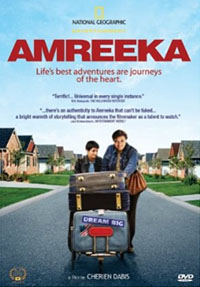 Like many films about immigrants, in many ways Amreeka tells a standard coming-to-America story of survival in an unfamiliar and often unwelcoming new land. But its great script and subtle, natural performances make Amreeka anything but a standard film about the immigrant experience. The feature film is now available on DVD

The feature film debut of Jordanian-American writer/director Cherien Dabis, Amreeka is the story of a divorced mother, Muna, and her teenage son, Fadi, who emigrate from the Palestinian territory to a small town in Illinois. After years of suffering the daily indignities of life in the West Bank (including ID checks and body searches at Israeli border checkpoints), Muna unexpectedly receives her green card. She and Fadi quickly leave for greener pastures in the American heartland, moving in with Muna's sister, Raghda, and her prosperous family.
The expected difficulties ensue: Despite her years of banking experience, Muna must settle for a job flipping burgers at White Castle, and Fadi has trouble fitting in at his new high school. Further complicating matters are the strained relationships in Raghda's family, as she, her husband, and their three young daughters try to find a cultural balance between the family's Palestinian past and its American present. All of this happens against a backdrop of all-American xenophobia, as the family deals with anti-Arab bigotry during the early days of the Iraq war. The story is set in 2003, shortly after the U.S. invasion of Iraq.
Fortunately, Amreeka avoids moralizing about tolerance, focusing instead on the family's resolve to defend itself against everything from juvenile insults to blatant discrimination. While the film does not hide its political point of view, the story is far more personal than political; it's less about geopolitics than about Muna and Fadi's interactions with their new world. The script is a bit short on plot, but long on sharp dialogue and realistic character development.
Amreeka is amusing and at times very moving, but the film's real strength lies in the thoroughly believable acting. Nisreen Faour delivers a nuanced and very funny performance as the often bewildered but generally fearless Muna, giving no hint that it's her first feature film role. Veteran actress Hiam Abbass (Lemon Tree, The Visitor, Munich) is equally terrific as the harried and homesick Raghda. Among the supporting cast, Alia Shawcat (Maeby Fünke on Arrested Development) is especially appealing as Raghda's rebellious (and thoroughly Americanized) teen daughter Salma.
I first saw and enjoyed Amreeka when it screened in Austin in September. It was just as entertaining on second viewing; like most small, character-driven films, it loses little in the transition to DVD. However, most of the DVD extra features -- deleted scenes, outtakes and a short film -- add little to the viewing experience. The four deleted scenes are very brief and apparently were deleted for the obvious reason: They add nothing essential to the story, although the most interesting one depicts Fadi's humiliating strip search at an airport. The three outtakes aren't particularly funny. (Curiously, one outtake is entirely in Arabic without subtitles, so its significance would be a mystery to viewers who do not speak Arabic.)
One extra I did enjoy is Dabis's 12-minute short film, Make a Wish, which follows a young Palestinian girl through the streets of Ramallah as she tries to raise enough money to buy a birthday cake. A seemingly trite story at first, Make a Wish becomes a poignant statement about life in the West Bank. This film is particularly interesting because it hints at the visual style and themes of Amreeka, which was released three years later.