

Review: The Young Victoria
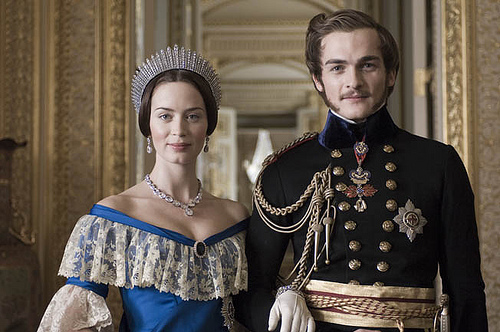
The historical biopic The Young Victoria focuses on the political struggles surrounding the throne of the United Kingdom of Great Britain as well as the romance of one of the most influential monarchs in history. Written by award-winning writer Julian Fellowes (Gosford Park), this film is a visually stunning and engaging portrayal of Victoria's ascent to the throne at a time when the monarch held few political powers.
The title character in The Young Victoria (Emily Blunt) is
the object of a royal power struggle. Her uncle, King William (Jim
Broadbent), is dying and Victoria is next in line for the throne. Everyone
is vying for her favor, but Victoria is kept from the court by
her overbearing mother, the Duchess of Kent (Miranda Richardson), who in turn is controlled by her own ambitious advisor, Lord Conroy (Mark Strong). Imposing the Kensingston system, the manipulative pair keep Victoria isolated in an attempt to keep her weak and therefore dependent on them.
Victoria’s cousin, Albert (Rupert Friend) is invited
to visit by her mother. Albert is also the nephew of her Uncle, King Leopold of Belgium (Thomas Kretschmann), who plots to position himself in control of the British throne by coaching Albert to win Victoria's hand in marriage. Well aware of the manipulations, Albert speaks openly with Victoria
and they become allies and begin writing one another -- much to the delight of King Leopold. He pushes Albert to woo Victoria, but Albert refuses. He does not believe that Victoria is ready to accept him and therefore won’t return to London until invited.
Following the death of King William, at 18 years of age, Victoria is crowned Queen of
England. Her first act is to banish her mother and Conroy to remote palace apartments, and take on Prime Minister Lord Melbourne (Paul Bettany) as her sole advisor. Prince Albert returns to
London for the coronation and his relationship with Victoria deepens. However, Albert observes Melbourne's influence over Victoria and he eventually returns to
Germany.
Victoria becomes entangled in other political machinations, but doesn't forget about Albert (as we probably all know).
The casting of The Young Victoria is even more impeccable than the costumes, led by Emily Blunt (The Devil Wears Prada) and her confident and intelligent portrayal of Victoria. I've adored Miranda Richardson for years due to her portrayal of Queen Elizabeth I in the Black Adder series, and she convincingly plays the manipulative Duchess of Kent. Rupert Friend (Pride and Prejudice) is charismatic as Lord Melbourne and veteran actor Jim Broadbent (Brazil, Vanity Fair) is delightful and endearing in his short screen time as King William.
The Young Victoria is full of rich and exquisite costuming and sets. Beyond being a period drama, this film is intelligently written and inspired me to learn more about the history surrounding Victoria's early reign. Some of the direction may seem slow-paced, but Jean Marc Vallee's direction could be attributed to the natural timing of historical events. Courtships often spanned years, and political and military maneuvers were also drawn out.
The Young Victoria is a treat for fans of period dramas such as The Madness of King George, as well as Jane Austen fans. This film may also inspire viewers to watch my favorite cinematic portrayal of Queen Victoria in her later years, the well-made British period film Mrs. Brown.