

New Releases
Movies This Year: Our Reviews of Upcoming Releases
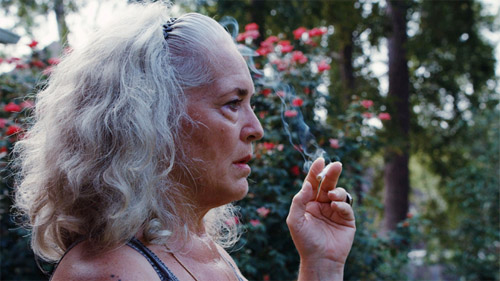
Slackerwood may be winding down, but the Austin film and festival scene is going strong. We've reviewed a number of movies at local and national film fests that have not yet had a full theatrical release. Many of them have Austin and/or Texas ties.
Reviews for movies with upcoming Austin theatrical/VOD release dates, where available:
- Results: 5/29, theatrical and VOD (Jette)
- The Connection: 5/29, theatrical (Debbie)
- Heaven Knows What: 5/29, theatrical (no Austin or VOD date yet) (Don)
- Balls Out (formerly Intramural): 6/19, theatrical (no Austin date yet) (Jette)
- Manglehorn: 6/19, theatrical and VOD (no Austin date yet) (Don)
- Creep: 6/23, iTunes; 7/14, Netflix (Mike)
- The Overnight: 6/26, theatrical (Jette)
Review: The Connection
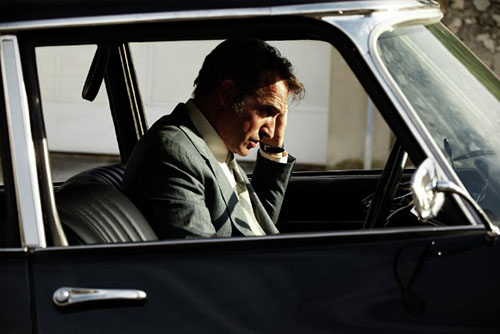 Whereas in many crime dramas the difference between the good guy and the bad guy is painted in black and white, writer and director Cedric Jimenez brings the more complex nature of both sides in the emotionally gripping movie The Connection. Based on the true story of French law enforcement's battle with the heroin-dependent drug traffic among France, New York and the rest of the world, this award-worthy film focuses more on the characterization of key players in the battle rather than rely on hyperviolence.
Despite his reluctance, French magistrate Pierre Michel (Jean Dujardin) is transferred from the juvenile to the organized crime division in the middle of mob wars in Marseilles, France. As a former gambling addict, Michel channels his obsessive nature into getting to the bottom of the complex network of drug lords, discovering that corruption exists at the top and around him.
The cornerstone to all the corruption is Gaëtan "Tany" Zampa (Gilles Lellouche), a racketeer who offers "protection" through the violent persuasive nature of his gang: Bimbo, Franky Manzoni (Moussa Maaskri), and Le Fou (Benoit Magimel). Zampa's expansion from prostitution and gambling into manufacturing and selling heroin places him at the top of the Marseilles crime scene, making him a target as well for the police and competitors.
Review: In the Name of My Daughter
All I knew in advance about In the Name of My Daughter was that it was based on a true story, just like another of French auteur Andre Techine's recent films, The Girl On The Train. I've been a fan of his work for almost as long as I've been watching world cinema. Rendez-vous, My Favorite Season, Wild Reeds and Changing Times represent some of the best that French cinema has had to offer in the last 30 years.
It really says something about the strong fashion sense of the French (or the fact that I watched it from a screener instead of on the big screen) that I didn't even realize this movie was set in the 70s until I glanced over at the press notes about 15 minutes in to verify an actor's name. There just wasn't anything to indicate the time period at all, I presumed it was a contemporary tale. I was very wrong, although the film does end up spanning over 30 years before the end credits roll.
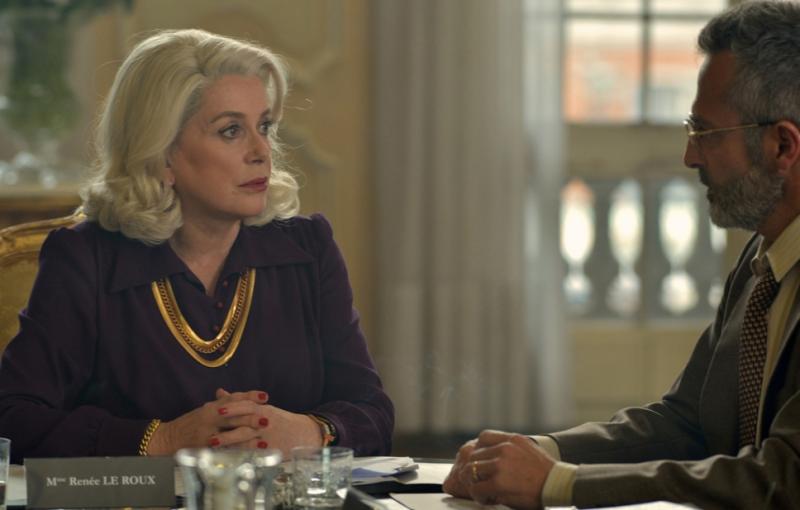
With In The Name of My Daughter (whose original title, L'homme qu'on aimait trop, oddly translates as The Man Who Was Loved Too Much), Techine teams up with legendary actress Catherine Denueve for the seventh time and gives her the juicy role of Renee Le Roux -- a casino magnate on the French Riviera who has inherited the Palais de la Mediterranee from her late husband. The film, based on her memoirs, gets underway on the shores of Nice in 1976.
Review: Poltergeist
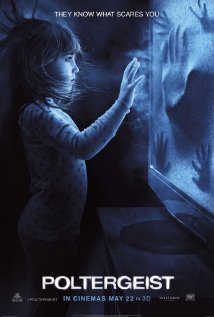 On Thursday, I saw the Gil Kenan (Monster House, City of Ember)-directed movie Poltergeist, a remake of Tobe Hooper's 1982 masterpiece. David Lindsay-Abaire (Oz the Great and Powerful, Rise of the Guardians) re-adapted the script from the original film, which had been conceived and co-written by Steven Spielberg. I expected the new movie to completely suck, so I'm surprised to disagree with many of my fellows and say that it's not great, but it's sort of okay.
If you haven't watched the 1982 Poltergeist, which stars Craig T. Nelson, JoBeth Williams and Zelda Rubinstein, do yourself a favor and stop reading now. Find it on disc or online. It's the apex of family horror films and the greatest haunted house movie ever made, so it's little surprise Kenan would be chosen to direct the remake, based on his earlier Monster House. Hooper's original figures heavily in this review, and you should be familiar with the story before you continue.
The differences in this version are immediately obvious. It's 21 minutes shorter, and everything feels rushed. Hooper's version was a slow burn that began with odd, whimsical events and descended into terrifying madness. The script Kenan directed jumps immediately into malicious attacks, before the family even moves into the house.
Before I dig into the weaker points of the new Poltergeist, I want to address the things I liked. I enjoyed Sam Rockwell more in this role than Craig T. Nelson in the original. Rockwell is more likable, more easygoing and more fallible. His chemistry with Rosemarie DeWitt is spot-on, and the kids are phenomenal. They play a larger role in this script, and they are all more believable characters. (Though I wonder why bother renaming them all?) Kenan uses light and shadow to great effect, and he doesn't shy away from the use of modern technology, so it's clear he's not trying to reproduce the original.
There are a few things I feel were missteps. While 3D is de rigueur for most studio releases lately, a number of shots are staged as if to specifically prove that you're seeing the film in 3D. A car placed immediately in the foreground of a wide shot of the house, early in the film, was annoying and distracting. Kenan cut the scene I found scariest in Hooper's version, but he spends a large portion of the film taking the camera into the "other side" breaking the rule of "don't show, tell."
Review: Tomorrowland
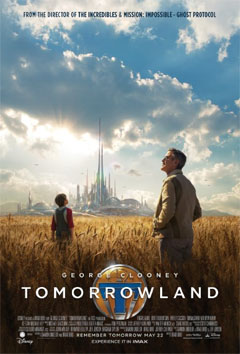 The last 10 minutes of a movie are often what shapes our opinion most -- a strong ending can soften our feelings about a bad movie, and a weak, tone-deaf ending can spoil a filmgoing experience far more thoroughly than any overly revealing trailer or review. Tomorrowland is often a breathtakingly gorgeous movie with charming performances, but the ending is so unabashedly lesson-driven and heavy-handed that it's difficult to remember anything but its flaws and missteps.
The movie's opening and closing scenes are meant as bookends, but these are bookends created by your clumsy kid brother in shop class on the day the nails ran short. The first scenes in particular feel like a hurried reshoot/restructure to get George Clooney onscreen earlier. Frank (Clooney) and Casey (Britt Robertson) are speaking directly into the camera, making a video for an unknown audience. With interruptions from Casey, Frank begins setting up the story through flashbacks to his childhood.
Young Frank (Thomas Robinson) visits the 1964 World's Fair -- which includes the Disney "It's a Small World" exhibit, natch -- to win an inventors' contest with his jet pack that doesn't ... quite ... work. He fails to impress the judge (Hugh Laurie) but young Athena (Raffey Cassidy) manages to sneak him access to a hidden, magical land, aka Tomorrowland (based on the Disney theme park).
The movie then abruptly shifts gears to Casey's story, which seems to be set in the near future -- her father is a NASA engineer, and she keeps trying to sabotage attempts to close Cape Canaveral down. Her unbounded optimism, interest in science and desire to fix everything catches Athena's attention, and she decides to introduce Casey to Tomorrowland too ... in the hopes that she can convince Frank, who's become even more you-kids-get-off-my-lawn than Clint Eastwood, to help them solve drastic problems affecting Tomorrrowland and the contemporary world.
Unfortunately, the entire concept of the Tomorrowland world feels weirdly Ayn Rand-ian and the movie feels at times like a pro-STEM propaganda piece aimed at kids. Filmmaker Brad Bird has never been subtle about messaging in family films such as The Iron Giant, The Incredibles and Ratatouille, but stellar storytelling with compelling characters took front and center. In addition, Tomorrowland is hampered by obvious Disney brand marketing, as off-putting as it was in Saving Mr. Banks.
Review: Mad Max: Fury Road
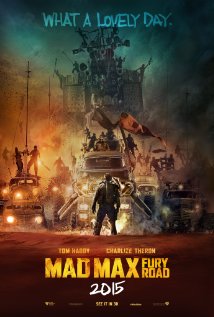 The bar is set this week for top action flick of the summer, and Mad Max: Fury Road is the one to beat. It has been an improbable 30 years since the last entry in the Mad Max series, Mad Max Beyond Thunderdome, but director George Miller returns with a joyride so big, so incredibly over-the-top, it's got the potential to redefine what we expect in an action film.
Miller immerses us in the post-apocalyptic world he established through the previous films, which we can now see has never stopped devolving and increasing in madness, chaos and destruction as the last vestiges of life continue to die off. The title "Mad Max" in fact is something of a misnomer, as Max Rockatansky, now played by Tom Hardy, is clearly the most sane person left in what has become the outer circle of Hell.
The world in Mad Max: Fury Road is the phenomenally stunning product of concept and art direction. The fully realized society is based on a religion devoted to its leader, who presides over warriors who feed on milk harvested from human slaves and who wish only to die in his service. Great machines powered by human feet lift vehicles from the bowels of his stronghold -- vehicles that might drive on stage at the heaviest of heavy-metal concerts, smoking frankencars pieced together, covered in skulls, with men chained to them spitting gasoline into their intakes to increase the RPMs.
Character names are just as ostentatious: Toast the Knowing, Rictus Erectus, The People Eater and The Splendid Angharad ... to name a few. Every detail of this fantasy is magnified, hyperbolized to an explosive extent. Michael Bay is no longer the director I refer to as the "best at blowing shit up."
We don't need another hero, but we get one in the bad-ass form of Imperator Furiosa (Charlize Theron). This is her story, and on Fury Road, Max is just along for the ride. There is no attempt to be subtle about the strong feminist message in the film, and that's A-OK. I would have been every bit as happy if this film had left out the Max character, and I'd love to see a set of movies in this world with Theron taking the lead.
Movies This Week: May 15-21, 2015
The Violet Crown Cinema has an encore screening of its Arthouse Monthly series Sunday night with the acclaimed new documentary I Am Big Bird: The Caroll Spinney Story. In her review, Jette says it's a "pleasant and sometimes touching profile of Caroll Spinney, who has spent decades portraying both Big Bird and Oscar the Grouch on Sesame Street and elsewhere." Tickets are on the verge of selling out, but if you miss out on this one-time local screening, the film is available now on cable and digital VOD from Tribeca Film. In addition, Violet Crown is holding over Austin-shot indie Arlo and Julie (Elizabeth's review) for another week, with daily screenings.
The Austin Film Society kicks off the weekend with Jess Franco's 1971 avant-garde horror film Vampyros Lesbos, which screens tonight at the Marchesa. On Sunday afternoon, AFS is teaming up with the Austin chapter of the National Alliance on Mental Illness for a 35mm benefit screening of the documentary The Devil and Daniel Johnston, a 2005 profile of the local musician/artist.
On Wednesday night, Richard Linklater is presenting one of his favorite films of the 80s, Tim Hunter's River's Edge in 35mm. He'll be on hand for an introduction and then to lead a post-film discussion for the "Jewels In The Wasteland" series. The AFS "Songs Of The South" Essential Cinema series is featuring Intruder In The Dust on Thursday night. This 1949 feature from Clarence Brown tells the story of a black farmer falsely accused of murder in the South and is presented in 35mm.
Review: Pitch Perfect 2
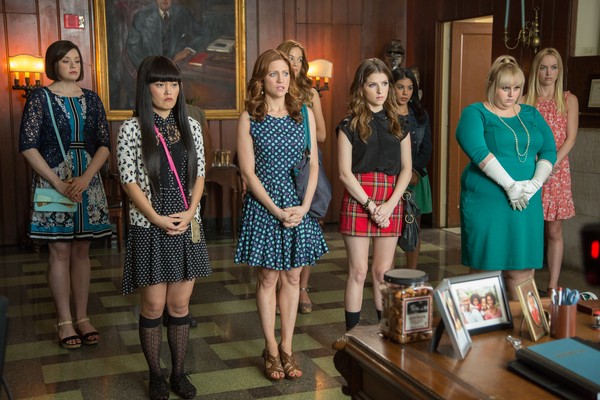
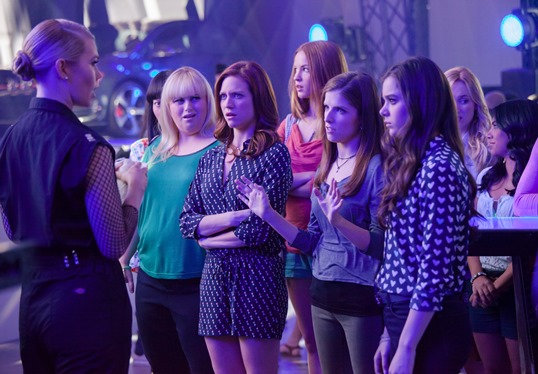
The Barden Bellas, with their zany vocal antics, are back. Elizabeth Banks, who produced Pitch Perfect the first, directs the new sequel -- as well as returning to her role as a cappella commentator Gail. Pitch Perfect 2 shows the collegiate group three years after their win at nationals.
So much is packed into this two-hour musical comedy, but I'll try to break it down for you. Beca (Anna Kendrick), with dreams of being a music producer, snags an internship at a studio and doesn't tell her friends. Fat Amy (Rebel Wilson) ruins a Bella performance at Lincoln Center and the group's performing duties as current national titleholders are stripped away. New freshman/legacy Bella Emily (Hailee Steinfeld, True Grit) joins the group and they plan to compete in an international a cappella competition in Denmark.
Pitch Perfect 2 skips from situation to situation -- it's more like a longform sitcom than any other movie I've seen recently. Unfortunately, the script includes some lazy and ridiculous writing. A Latina Bella (Chrissie Fit) is relegated to stereotype, stuck with cringeworthy comments to the other girls about her brother trying to barter her for a chicken, or her likely being deported after college and coming back illegally. Besides her flipping skills, her character is basically a caricature. The limitations of the first film haven't been improved on in this regard.
Review: I Am Big Bird: The Caroll Spinney Story
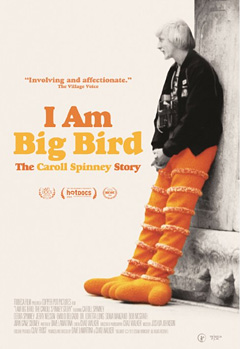 The documentary I Am Big Bird: The Caroll Spinney Story is exactly what you'd expect it to be, if you're a Muppet fan ... and also exactly what you'd hope it would be. Tonight's Violet Crown screening is sold out, but you can watch the film via online streaming outlets such as Amazon, iTunes and Vudu.
The film is a pleasant and sometimes touching profile of Caroll Spinney, who has spent decades portraying both Big Bird and Oscar the Grouch on Sesame Street and elsewhere. It's traditionally structured, primarily by time sequence -- beginning with his childhood and early puppet and acting gigs, and heading for the present. Interviews with Spinney help form the backbone of the film -- he tells us his own history, supported by other interview from his family to Sesame Street colleagues such as Frank Oz, Joan Ganz Cooney and Norman Stiles.
Naturally I Am Big Bird includes a great deal of vintage Sesame Street and Muppet footage, starting from the days when Oscar was orange and Big Bird didn't have quite so much plumage. The footage is delightful but also occasionally poignant -- it's impossible to talk about Big Bird without mentioning the episode about Mr. Hooper's death, and it's impossible to talk about Muppet history without mentioning Jim Henson's death.
Although the structure is fairly traditional, filmmakers Dave LaMattina and Chad N. Walker manage some excellent segues that cover a lot of ground. For example, after showing scenes from Jim Henson's memorial, Spinney and Oz discuss Steve Whitmire taking over Kermit's character, which naturally leads to addressing what will happen when Spinney retires, and introduces his Big Bird apprentice, Matt Vogel. An early sequence about the filming of Big Bird in China pays off later in the film in a way that may be predictable but is no less affecting.
Review: Welcome To Me
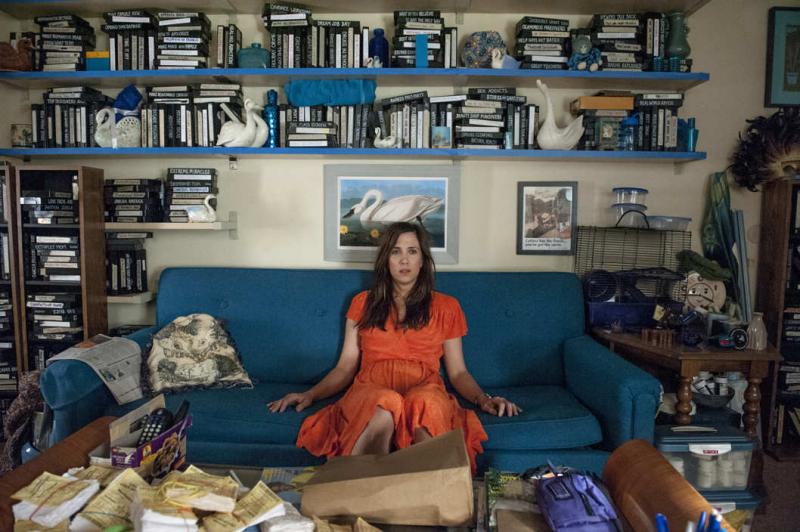
In her seven seasons as a cast member on Saturday Night Live, Kristen Wiig became known for an array of bizarre recurring characters and for taking on difficult and highly memorable impressions (Bjork, Kathie Lee Gifford and Suze Orman spring immediately to mind). She's done her fair share of comedic film work, but in the last few years has really found her niche in indie dramadies. With The Skeleton Twins and Hateship Loveship under her belt, Wiig now appears in her strongest performance to date in Welcome to Me as Alice Klieg, a woman with borderline personality disorder.
The concept works because it is too absurd to be true. Essentially, it begins with the fact that Alice has a complicated relationship with television. It has comforted, cared and educated her over the years. Despite her mental issues, she's stopped taking her prescribed medications and relies on piles of VHS tapes to calm her nerves. She leaves the television on in her apartment at all times, telling a visitor to her home that it hasn't been turned off in 11 years. Before she can go out into the world, Alice will sit down and pop in an old Oprah episode into the VCR, reciting every line of dialogue. To her, these Oprah episodes have been a better guide for living her life than the time spent with her therapist (Tim Robbins). Spontaneity is not Alice's specialty, often expressing her feelings in "prepared statements" handwritten in advance to spare her from getting too emotional in the heat of the moment.
One night, Alice turns on the California Lottery and matches the numbers to her recently purchased ticket to discover that she has won a massive $86 million dollar jackpot. Without the checks and balances of proper care for her illness, her newfound wealth enables her to invest in the lifelong dream of having her own talk show. She teams up with New Vibrant Studios, home to a struggling local home-shopping network owned by brothers Rich (James Marsden) and Gabe (Wes Bentley) and offers to pay upfront to produce her show, which quickly goes from a weekly program (entitled Welcome To Me, with increasingly more complex opening title sequences as the show goes on) to a daily one.
